
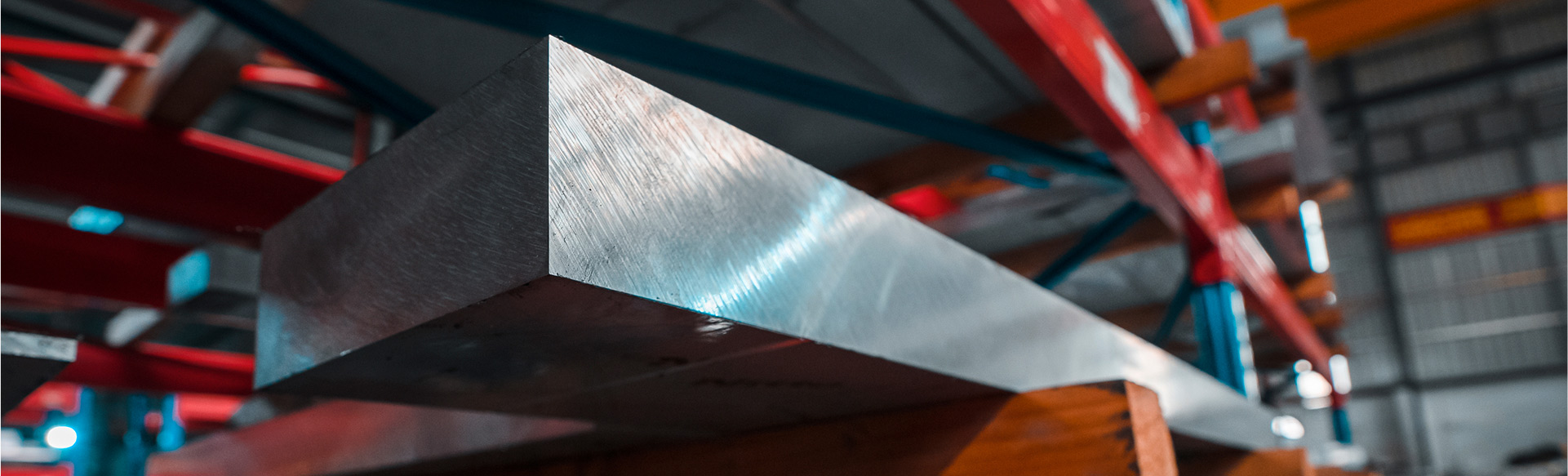
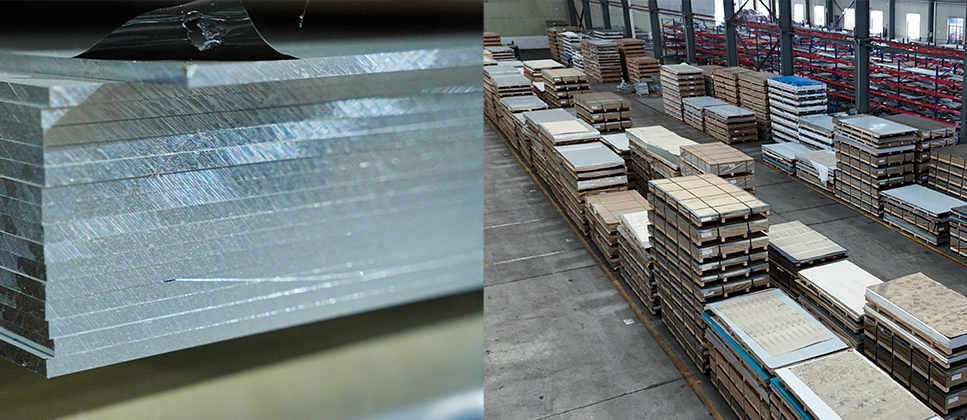
7075 aluminum plate belongs to the Al-Zn-Mg-Cu series of ultra-high strength aluminum alloys, known as the "king of aviation aluminum", with strength close to steel (tensile strength ≥ 500MPa) and excellent fatigue performance, but sacrifices some corrosion resistance and weldability, and is widely used in aerospace, military and high-end machinery fields.
National Standard (GB/T): 7075 (old grade LC9).
American Standard (AMS): AMS 4045 (aerospace grade), ASTM B209.
European Standard (EN): EN 573-3 (AlZn5.5MgCu).
ISO standard: AlZn5.5MgCu (ISO 209).
Main component range (mass percentage)
Elements | Content range (%) | Function |
Zinc (Zn) | 5.1~6.1 | Main strengthening element, forming MgZn₂ phase |
Magnesium (Mg) | 2.1~2.9 | Synergistic with Zn to improve the aging hardening effect |
Copper (Cu) | 1.2~2.0 | Enhance strength and heat resistance |
Chromium (Cr) | 0.18~0.28 | Inhibit intergranular corrosion |
Silicon (Si) | ≤0.40 | Impurity control |
Iron (Fe) | ≤0.50 | Impurity control |
Features:
High zinc and high copper → Extremely high strength, but poor corrosion resistance (surface protection required).
Chromium addition → Reduces stress corrosion tendency.
State | Tensile strength (MPa) | Yield strength (MPa) | Elongation (%) | Hardness (HB) |
T6 (solid solution + artificial aging) | 510~540 | 430~480 | 5~10 | 150~175 |
T73 (time expired) | 450~490 | 390~420 | 7~12 | 130~150 |
O (annealing) | ≤230 | ≤100 | ≥12 | ≤60 |
Note:
T6 state: highest strength, but high stress corrosion sensitivity.
T73 state: sacrifice 10% strength in exchange for corrosion resistance (commonly used in aviation components).
Density: 2.81 g/cm³ (slightly higher than other aluminum alloys).
Melting point: 475~635℃.
Thermal conductivity: 130 W/(m·K) (lower than 6061).
Electrical conductivity: 33% IACS (poor conductivity).
Thermal expansion coefficient: 23.6×10⁻⁶/℃ (20~100℃).
Advantages:
Ultra-high strength: T6 state tensile strength exceeds 500MPa, comparable to low carbon steel.
High fatigue strength: suitable for dynamically loaded parts (such as aircraft landing gear).
Good machinability: high surface finish (but tool wear is fast).
Disadvantages:
Poor corrosion resistance: requires anodizing or coating protection (especially avoid chloride ion environment).
Very poor weldability: fusion welding is prone to cracking, riveting or bolting is recommended.
Expensive: the cost is 2~3 times that of 6061.
Aerospace:
Aircraft wing beams, landing gear, missile shells (US military standard AMS 4045).
Spacecraft load-bearing frames, satellite components.
Military equipment:
Armored vehicle bulletproof plates, firearms parts (such as M16 rifle receivers).
High-end machinery:
Precision molds, high-speed spindles, racing suspension links.
Sports equipment:
Trekking poles, bicycle racks (surface treatment for corrosion protection is required).
(1) Heat treatment process
Solution treatment: 465~480℃ insulation followed by water quenching (must be cooled quickly).
Artificial aging:
T6: 120~130℃ aging for 24 hours.
T73: Two-stage aging (110℃+160℃) to improve corrosion resistance.
(2) Machining recommendations
Tools: carbide or diamond-coated tools.
Cutting parameters: low speed, high feed, sufficient cooling.
(3) Welding and connection
Fusion welding (use with caution): requires special welding wire (such as ER5356), and T6 treatment is performed immediately after welding.
Alternative solutions:
Riveting: aviation-grade rivets (such as 2117-T4).
Gluing: epoxy resin + surface anodizing.
Hard anodizing: film thickness 50~100μm (hardness HV1000+).
Micro-arc oxidation (MAO): forms a ceramic layer, and the corrosion resistance is increased by 10 times.
Electroplating zinc/nickel: used in high salt spray environment (such as ship parts).
